August 2009: UNFOLDING THE LAND OF MOON
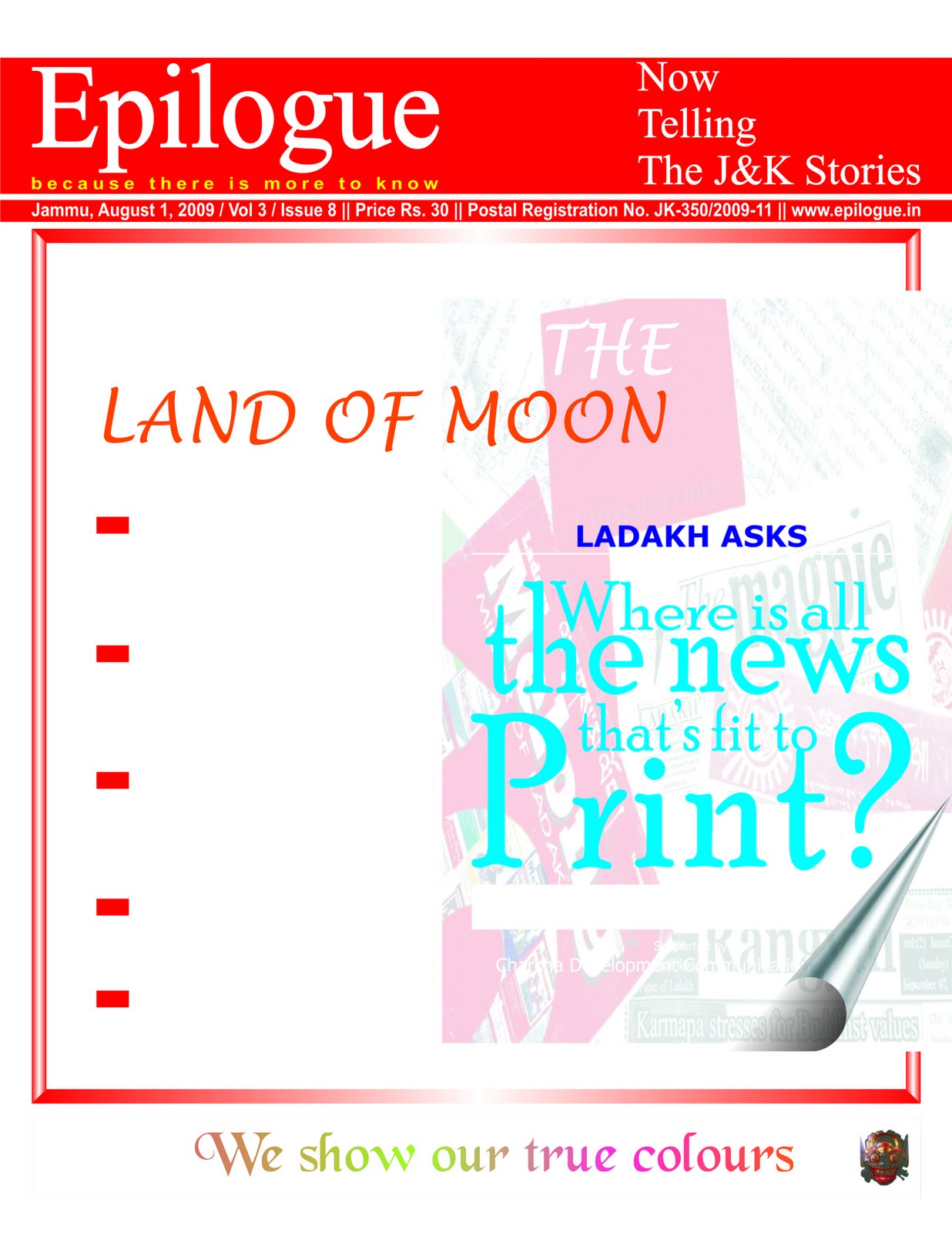
August 2009 issue was one of the path-breaking in the life of Epilogue magazine. The cover story explored many aspects of life in Ladakh and carried a first hand of research on the state of media in the Himalayan cold desert.
Showing posts with label Epilogue Titles. Show all posts
Friday, November 20, 2009
June 2009: LOK SABHA POLLS 2009
With Prof. Rekha Chowdhary looking into various aspects, the May issue offered a complete view of the Lok Sabha elections in Jammu and Kashmir. An interview with Finance Minister Abdul Rahim Rather explained most critical questions on the state’s economy.
April 2009: TREADING FAILURE
As world watches keenly the new unfolding developments in Pakistan, our consulting Editor D Suba Chandran traveled to the troubled country to bring fresh perspectives for our readers in April issue.
February 2009: AGENDA FOR OMAR GOVERNMENT
The coalition government of National Conference and the Congress headed by Omar Abdullah took over on January 5 but it did not declare a shared agenda. Epilogue’s February issue put together opinions of well meaning people from across the country setting out an agenda Omar Abdullah government.
December 2008: HUNG ASSEMBLY
In the middle of elections our small team of staffers along with some 30 volunteers traveled across the length and breadth of Jammu and Kashmir to gauge the public mood. The conclusion was that there will be a hung assembly with NC as largest party, PDP second and Congress third. Looking at the pages of our December issue one can see all parties have come up with same number of seats as we had predicted except the BJP.
October 2008: INTRA-KASHMIR CONTACTS AND TRADE
Shortly before the historic cross-LoC trade was launched between two parts of Jammu and Kashmir, the United States Institute of Peace had come up with a most comprehensive study on making borders irrelevant. Under a special endowment from USIP, Epilogue carried reproduced the study in fall. It was a painstaking research taken by Hassan Askari and PR Chari, two leading policy experts of Pakistan and India, respectively.
August 2008: FALL OF COALITION
The coalition government peoples PDP and the Congress had come up with a Common Minimum Program at the time of its formation in 2002. When the government fell down in July 2008 after a bitter acrimony between coalition partners, they went out without leaving a report card on their performance. Epilogue brought out a point-wise examination of all 30 points contained in the CMP of governance and concluded that the pledges were forgotten.
June 2008: CROSS-LOC TRADE
Trade across the Line of Control has arguably been the mother of all confidence building measures between India and Pakistan involving Jammu and Kashmir. Epilogue was arguably the first news and current affairs publication to come up with a comprehensive issue on broad contours of Cross-LoC trade. The bottlenecks we had talked about were later evident when trade was actually initiated in October.
April 2008: FOOD SECURITY
In the thick of politics the crucial issues of food and shelter are often lost. Our April 2008 issue dealt with the question of food security in Jammu and Kashmir and that perhaps the most comprehensive coverage of the subject. A lead essay by father of green revolution MS Swaminathan left hardly any thing to add. State Agriculture Minister gave the policy vision and Vice Chancellors of two Agriculture Universities in J&K made an elaborate account of research and technology in making Jammu and Kashmir food secure.
February 2008: MONEY MOVEMENT
This issue came after presentation of J&K’s annual budget and therefore carried a comprehensive analysis of the proposals made therein. As members of ruling coalition and opposition locked horns leaving almost no scope of debate inside assembly, we carried it here in the magazine. Finance Minister wrote for Epilogue what he could not say in assembly. There are articles from Abdul Rahim Rather, the leader of opposition who was also the former Finance Minister and interview with Mohammad Shafi another Finance Minister
December 2007: FORESTS & FORESTERS
Jammu and Kashmir should have been known better in country for its supposedly thick forest cover. The fact of the matter, however, is that now it is known more its depleting greenery. At a time when protection of forests appeared a non-priority and their exploitation had become a rank priority in the government we dared to bring out this special issue which was taken by a pinch of contempt by department’s top brass. Nevertheless, government institutions, forest agencies and non-governmental organization dealing with subject are still writing us for copies of this issue.
EPILOGUE: October 2007
60 YEARS OF CONFLICT
It was the month of October 1947 that the events, one after the other, pushed Jammu and Kashmir into a most enduring of the conflicts world saw in recent history. That no two people have been seen or heard sharing same opinion on Kashmir issue, we requested many to send in their view points. Few of them responded with their understanding. Notable among them were Wajahat Habibullah, Syed Ali Shah Geelani, Abdul Aziz Zargar, Masud Chaudhary, MY Tarigami, Iftikhar Geelani and KN Pandita. In their own perspective, the authors trace genesis of conflict and its journey over 60 years.
EPILOGUE: August 2007
JK & 60
The problem with our younger generation in understanding Jammu and Kashmir is that they know very little about past. They key events most of the people in our age remember are the partition and wars. Our August 2007 issue was essentially a commemorative volume chronicling metamorphosis of change Jammu and Kashmir underwent from 1947 to 2007. Every key development arranged in a sequential order made this issue an essential reference on J&K. Which is why August 2008 issue is still in demand not only from across the country but also from abroad.
EPILOGUE: June 2007
LOOKING BEYOND ‘K’ ISSUE
What we tried to underline in our June 2007 issue became dominant nationwide cry exactly a year later. In June 2008 thousands of people in Jammu were on streets and the state was engulfed in a fire of regional and communal hatred. This issue was a forewarning on the fallout of a skewed political approach. Our main argument was based on the premise that external dimensions of Kashmir issue can be resolved by force or by diplomacy but no resolution can be lasting without addressing the internal dimensions.
EPILOGUE: April 2007
THE VOTE BANK STANDOFF
Describing themselves as natural allies at the time of formation of coalition government in October-November 2002, uncalled for conflict between PDP and Congress started showing towards the end of 2006. It reached almost a point of no return on March 2007 when Prime Minister Manmohan Singh intervened to save the coalition form a disastrous fall. Our April 2007 issue, thus, came out with a fearless commentary on the politics of vested interests. This issue also carried an interview with Zulfikar Abbasi, president of PaK CCI who later led a trade delegation to J&K in October 2008.
EPILOGUE: MARCH 2007
BAGLIHAR AND OTHER CHESTNUTS
In the backdrop of World Bank appointed neutral expert Prof Raymond Lifette’s award on Baglihar hydro-electric project on Chenab, our March issue focused on management and resolution of conflicts between India and Pakistan. Indus Water Treaty one such agreement between both countries which withstood all harshest tests of the times since 1960 and this was first time ever that both countries first agreed to appointment of a third party arbitration and then both accepted the award describing it s victory in their own way.
EPILOGUE: February 2007
THE PROMISES AHEAD
Year 2007 began in Jammu and Kashmir really on a promising note. There was a huge push to the peace process and the talk of Cross-LoC trade gained currency. We interviewed Mirwaiz Umar Farooq a day before left for Pakistan and the Pak administered Kashmir tour. He talked of ‘imaginative solution’ to Kashmir issue. Almost same sentiment was echoed by Syed Ali Shah Geelani in another exclusive interview. State budget advanced by two months promised a massive employment program to take the youth out of quagmire.
Subscribe to:
Posts (Atom)


